
Kia Rio: Automatic Transaxle System / Automatic Transaxle Control System
Description and operation
| Description |
Automatic transaxle control system relies on various measurements to determine the current control status and determine the necessary compensation values. These values are used to control the actuators and achieve the desired control output.
Operation
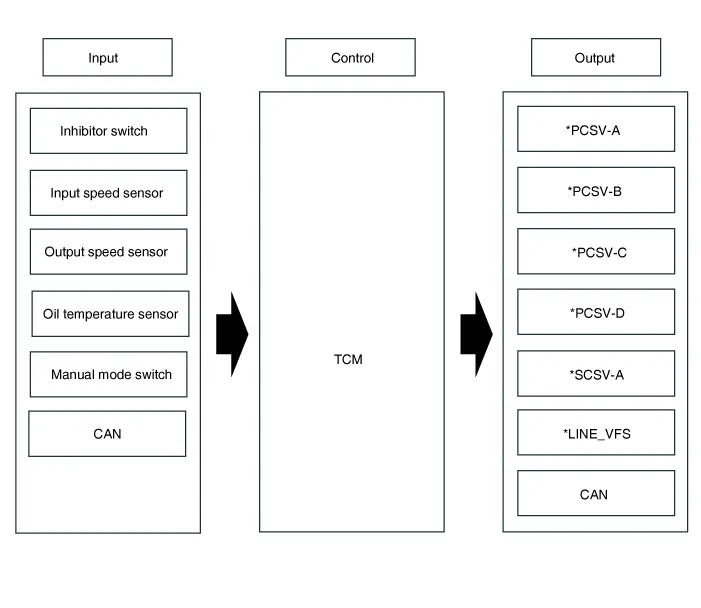
*PCSV-A : Overdrive clutch, Low&Reverse brake control solenoid valve
*PCSV-B : 24 brake control solenoid valve
*PCSV-C : Underdrive clutch control solenoid valve
*PCSV-D : Torque converter control solenoid valve
*SCSV-A : ON/OFF solenoid valve
*LINE_VFS : Line pressure control solenoid valve
Repair procedures
| Adjustment |
TCM adaptive values learning
| • |
TCM adaptive values learning : When shift shock occurs or parts related with the transaxle are replaced, TCM learning should be performed. |
| • |
In the following case, TCM learning is required. |
| – |
Automatic transaxle assembly replacement |
| – |
TCM upgrade or replacement |
TCM adaptive values learning procedure
| • |
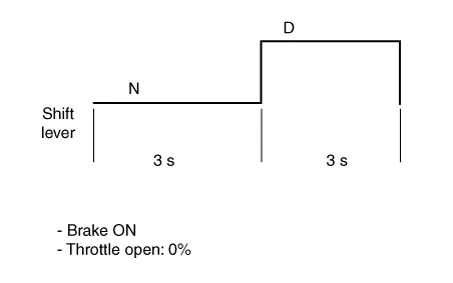
Static relearn (condition : ATF temperature 40 - 100°C (104 - 212°F) |
| 1) |
Step on the brake, and then pause for 3 seconds each on "N" range and "D" range. |
| 2) |
Repeat the above procedure four times.
|
| • |
Driving relearn |
| 1) |
Drive the vehicle through all the gears. (1st → 2nd → 3rd → 4th )
|

| 2) |
Decelerate the vehicle by stepping on the brake (4th → 3rd → 2nd → 1st). |
| 3) |
Repeat the above procedure four times. |
- Transaxle Control Module (TCM)
- Transaxle Oil Temperature Sensor
- Input Speed Sensor
- Output Speed Sensor
- Inhibitor Switch
- Shift Lever
- Shift Cable
Specifications Specifications Automatic Transaxle Item Specification Transaxle model A4CF1 Engine model Gasoline 1.
Description and operation Description The module receives and processes signals from various sensors and implements a wide range of transaxle controls to ensure optimal driving conditions for the driver.
Other information:
Kia Rio 2017-2023 YB Service Manual: Indicators And Gauges
Troubleshooting Troubleshooting Error Item Failure symptom Inspection items Detailed inspections Relevant Parts/ Components Screen display LCD screen does not turn on 1) Connector attachments
Kia Rio 2017-2023 YB Service Manual: Air Conditioning System
General safety information and caution Instructions When Handling Refrigerant 1. R-134a liquid refrigerant is highly volatile. A drop on the skin of your hand could result in localized frostbite. When handling the refrigerant, be sure to wear gloves.
Categories
- Manuals Home
- Kia Rio Owners Manual
- Kia Rio Service Manual
- Engine Mechanical System
- Maintenance
- Heating,Ventilation, Air Conditioning
- New on site
- Most important about car
