
Kia Rio: Engine Oil and Filter / Fuel Filter (For Diesel engine only)
Repair procedures
| Replacement |
| 1. |
Turn ignition switch OFF and disconnect the negative (-) battery terminal. |
| 2. |
Remove the battery. (Refer to Engine Electrical System - "Battery") |
| 3. |
Remove the ECM. (Refer to Engine Control / Fuel System - "ECM") |
| 4. |
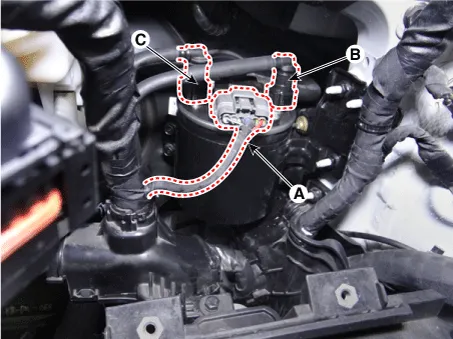
Disconnect the water sensor heater connector (A). |
| 5. |
Disconnect the fuel inlet tube (B) quick-connector and the fuel outlet tube (C) quick-connector.
|
| 6. |
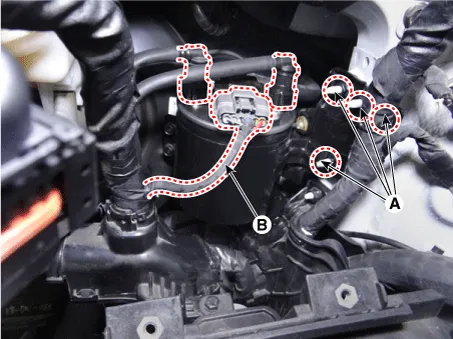
Remove the fuel filter assembly (B) after loosening the mounting nuts (A).
|
| 7. |
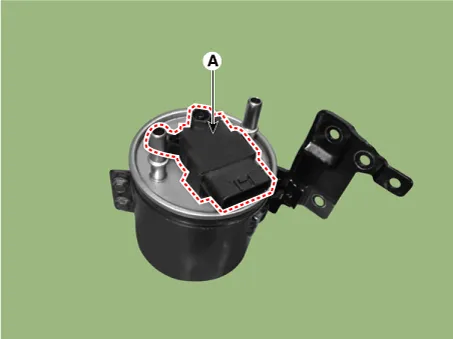
Remove the fuel heater & water sensor (A) after loosening the mounting bolt.
|
| 8. |
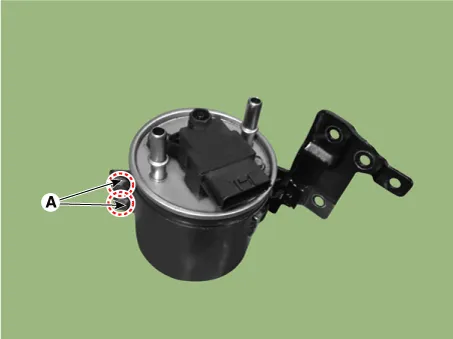
Remove the fuel filter assembly from the bracket after removing the bracket bolts (A), replace it with a new one, and then install the fuel filter assembly in accordance with reverse of above steps.
|

| 9. |
Bleed air in low pressure fuel circuit. (Refer to Engine Control / Fuel System - "Bleeding air procedure in low pressure fuel circuit") |
| 10. |
Start the engine and check that there is any leak on the low pressure fuel circuit including the fuel filter. |
| 11. |
Install in the reverse order of removal. |
Repair procedures Inspection Automatic Transaxle Fluid (ATF) Level Check 1. Place the vehicle on a level ground. 2.
Repair procedures Inspection Visually check the fuel lines for cracks, leakage, loose connections, deformation or tank band looseness.
Other information:
Kia Rio 2017-2023 YB Service Manual: Power Door Lock Module
Components and components location Components 1. Door lock/unlock knob cable 2. Door latch assembly Repair procedures Inspection • When removing with a flat-tip screwdriver or remover, wrap
Kia Rio 2017-2023 YB Service Manual: Windshield Wiper-Washer Switch
Repair procedures Removal [BCM Type] 1. Disconnect the negative (-) battery terminal. 2. Remove the steering wheel. (Refer to Steering System - "Steering Wheel") 3.
Categories
- Manuals Home
- Kia Rio Owners Manual
- Kia Rio Service Manual
- Fuse/relay panel description
- Engine Electrical System
- Cooling System
- New on site
- Most important about car
