
Kia Rio: SRSCM / Side Impact Sensor (SIS)
Description and operation
| Description |
| • |
Side Impact Sensor (SIS) system consists of two Pressure Side Impact Sensor (P-SIS) which are installed at each center of the front door module (LH and RH). |
| • |
Pressure Side Impact Sensor is also called P-SIS because it detects pressure due to collision at its mounting location. |
| • |
Side Impact Sensor is also called A-SIS because it detects acceleration. |
| • |
SRSCM decides deployment of the airbag and the time of deployment through the collision signal of the SIS when the collision occurred. |
Components and components location
| Components |

| 1. Pressure side impact sensor
(P-SIS) |
2. Front Gravity Side Impact
Sensor (G-SIS) |
Repair procedures
| Removal |
Pressure side impact sensor (P-SIS)
| 1. |
Disconnect the battery negative terminal, and wait for at least thirty seconds before beginning work. |
| 2. |
Remove the front door trim. (Refer to Body - "Front Door Trim") |
| 3. |
Remove the pressure side impact sensor (A).
|

| 4. |
Loosen the side pressure sensor mounting screw, and remove the sensor (A).
|
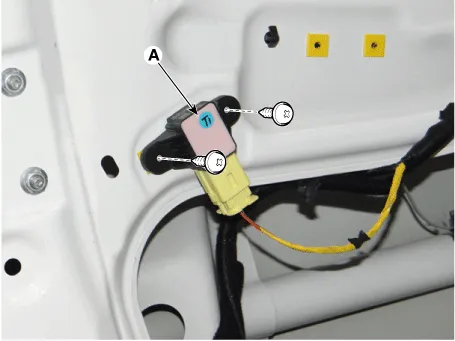
Front Gravity side impact sensor (G-SIS)
| 1. |
Disconnect the battery negative terminal, and wait for at least thirty seconds before beginning work. |
| 2. |
Remove the center pillar trim. (Refer to Body - "Center Pillar Trim") |
| 3. |
After disconnecting the side impact sensor connector (A) and loosening the bolt(B), remove the sensor.
|
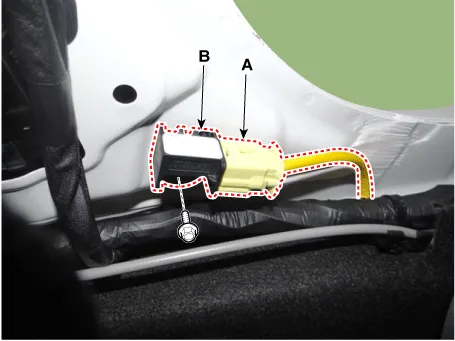
| Installation |
Pressure side impact sensor (P-SIS)
| 1. |
Disconnect the battery negative terminal, and wait for at least thirty seconds before beginning work. |
| 2. |
Install a pressure side impact sensor screws.
|
| 3. |
Connect the pressure side impact sensor.
|
| 4. |
Install the front door trim. (Refer to Body - "Front Door Trim") |
| 5. |
Reconnect the battery negative terminal. |
| 6. |
After installing the pressure side impact sensor, confirm proper system operation: • Turn the ignition switch ON; the SRS indicator light should be turned on for about six seconds and then go off.
|

Front Gravity side impact sensor (G-SIS)
| 1. |
Disconnect the battery negative terminal, and wait for at least thirty seconds before beginning work. |
| 2. |
Connect the side impact sensor connector (A) and then tighten the bolt (B).
|
| 3. |
Install the front door trim. (Refer to Body - "Front Door Trim") |
| 4. |
Reconnect the battery negative terminal. |
| 5. |
After installing the side impact sensor, confirm proper system operation: • Turn the ignition switch ON; the SRS indicator light should be turned on for about six seconds and then go off. |
Description and operation Description • The front impact sensor (FIS) is installed in the Front End Module (FEM). They are remote sensors that detect acceleration due to a collision at its mounting location.
Description and operation Description The SRSCM shall monitor the status of the driver and front passenger seat belt buckle. The SRSCM provides one pin each for the driver and front passenger seat belt buckle status input.
Other information:
Kia Rio 2017-2023 YB Service Manual: Rear Washer Switch
Repair procedures Inspection Multifunction Switch Inspection [BCM Type] 1. Check for continuity between the terminals in each switch position as shown below. [Left Handle Drive] Switch Switch position Switch terminal
Kia Rio 2017-2023 YB Service Manual: Sunroof
C
Categories
- Manuals Home
- Kia Rio Owners Manual
- Kia Rio Service Manual
- Body (Interior and Exterior)
- Maintenance Schedule
- Engine Oil and Filter
- New on site
- Most important about car
